


















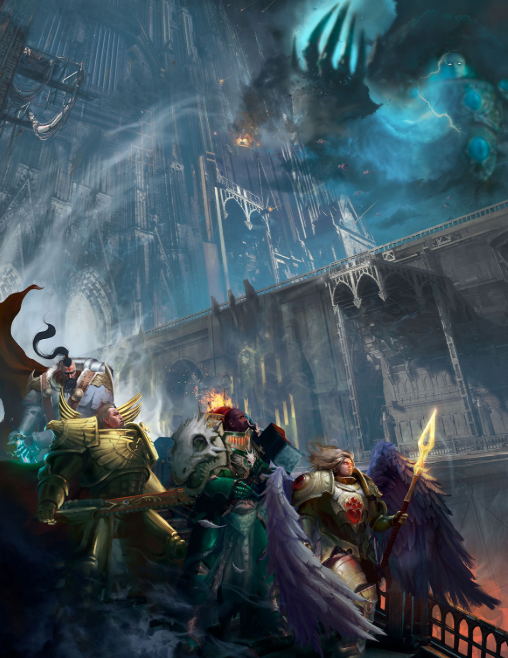
Picture a galaxy in flames.
Picture a humanity at war with itself, a conflict whose consequences will last for millennia to come and even now ripple across the stars. The very laws of time and space are bending and beginning to break; even the birthplace of mankind is not safe.
It is the end and the death. Brother wars against brother,friend against friend, father against once-favoured son, who has now come to kill him.
Suffice to say, it’s intense and quite complex. It’s certainly not for the faint of heart, but even still, it’s a read I’d highly recommend. First, though, a bit of context and a small disclaimer.
You may have heard of a little thing called Warhammer 40k. If you haven’t, or you have but the term means nothing to you, it’s most prominently a tabletop war game that involves tape measures, gambling, and a surprising amount of arts and crafts. It is often included in discussions of the literary idea of “grimdark,” being the prime example and even origin of the term: as the tagline states, “In the grim darkness of the far future, there is only war.” That tagline sums up the setting fairly well: it is forty thousand years in the future, everything sucks, and everyone’s at war with each other all the time. There are a bunch of factions to choose from, but there is just about no hope for any of them (except maybe the Orks). On the surface, there isn’t exactly a lot going on, but a closer look reveals quite the opposite — and there is perhaps no greater example of this than the subject of the Horus Heresy.
In horrendously, disgustingly oversimplified terms, the Horus Heresy was a great civil war among various forces in the Imperium of Man (that is, humanity’s descendant faction) set ten thousand years before the current events of 40k (the 31st millenium, for those keeping track). It sets the stage for the crumbling, decaying empire the Imperium is currently, and is perhaps one of the most detailed parts of the lore, spanning over — and I’m hardly exaggerating — 60 volumes written by a dozen authors.
Here is where the disclaimer comes in: The End and the Death trilogy is the very, very end of that series; as such, it requires quite a bit of context to fully understand that those new to Warhammer are rather likely to have missed. The myriad of YouTube videos on the subject helps, but it’s certainly not the best place to start, especially for those who don’t know the first thing about 40k. However, if you’re the same brand of slightly insane as me and feel inclined to take on the challenge, I daresay you’ll come out on the other end with one of the best experiences modern publishing has to offer.
A primary reason for this, and one that is immediately obvious, is the way it depicts the war in question. The reader’s perspective is ever-shifting from chapter to chapter — and occasionally even within chapters — as each one details the events of the book from different angles: frightened civilians; soldiers in the throes of battle; commanders and control teams desperately trying to make headway against the threat of Chaos (the esoteric emotion-magic-hell dimension the traitors have sided with) and establish contact with reinforcements; even second-person narration that places you, the reader, directly in the position of Horus Lupercal, the renegade Warmaster himself. It can be a little disorienting at first, yes, but it doesn’t take long to get the hang of, and I found that the little details it focuses on made the situation all the more tense and emotionally loaded. Everyone seems panicked and weary in a thousand different ways, and the deeper into the novel you go, the more you get connected to each of the stories presented within its pages.
All of this may seem rather bleak and hopeless, and it is — this is grimdark, after all! But this dark backdrop makes the little victories and moments of tenderness shine all the brighter. The few ordinary people who take a stand against the existential threat, trying to save whoever they can; the hail Mary transmission that confirms loyalist reinforcements are on the way; the characters’ sacrifices and determination to face the bitter end — I’m trying not to spoil anything here because it’s just that fantastic. Even the characters I didn’t go into the book for I ended up invested in, and the ones that I had cared about beforehand…well, I could probably write a whole other article about Sanguinius if I wanted to, but the tragedy of the Great Angel is a long one meant for another day.
I could go on, of course — literary, cultural, artistic references; musings on the nature of humanity (even one exchange that made me cry in Spanish class) — but this article is already rather long, and I want to give away as little as possible. Put simply, it’s utterly fantastic despite (I’d even argue because of) its almost dizzying complexity and certainly the start of a fitting conclusion to an epic such as the Horus Heresy. I’d highly recommend it, even for those who haven’t understood a word of this article — the atmosphere alone more than makes up for the lack of context you may have, and there’ll always be the Internet and the dramatis personae in the front of the book (another selling point for me personally) if you get confused.